Choosing disposable syringes and needles in 2026 requires more than comparing prices or package counts. Product quality affects every step, from opening a sterile wrapper to disposing of a used needle. The World Health Organization’s Global Report on Infection Prevention and Control (2022) estimates that seven out of every 100 acute-care patients in high-income countries acquire at least one healthcare-associated infection. The estimate rises to 15 in low- and middle-income countries. These figures make basic injection safety highly practical, not theoretical.
This guide examines barrel clarity, plunger movement, needle sharpness, protective caps, packaging integrity, and applicable standards such as ISO 7886-1 and ISO 7864. It also explains How to safely use disposable syringes and needles in clinical, vaccination, and home-care settings, following guidance from the Centers for Disease Control and Prevention’s Injection Safety recommendations. A new syringe and needle must be used for each patient and each injection. Never reuse them. Check the seal first. Inspect the needle under good lighting. A bent tip, damaged package, or unclear graduation requires replacement.
Small details matter.
In real workplaces, preparation areas become crowded, labels are misread, and disposal containers fill unexpectedly. No checklist is perfect, and even trained staff can overlook one step during fatigue or urgency. That weakness deserves honest attention. Safe practice therefore combines reliable products, verified training, clean preparation surfaces, hand hygiene, and immediate sharps disposal. This overview is educational and does not replace instructions from a licensed healthcare professional, product manufacturer, or local infection-control policy.
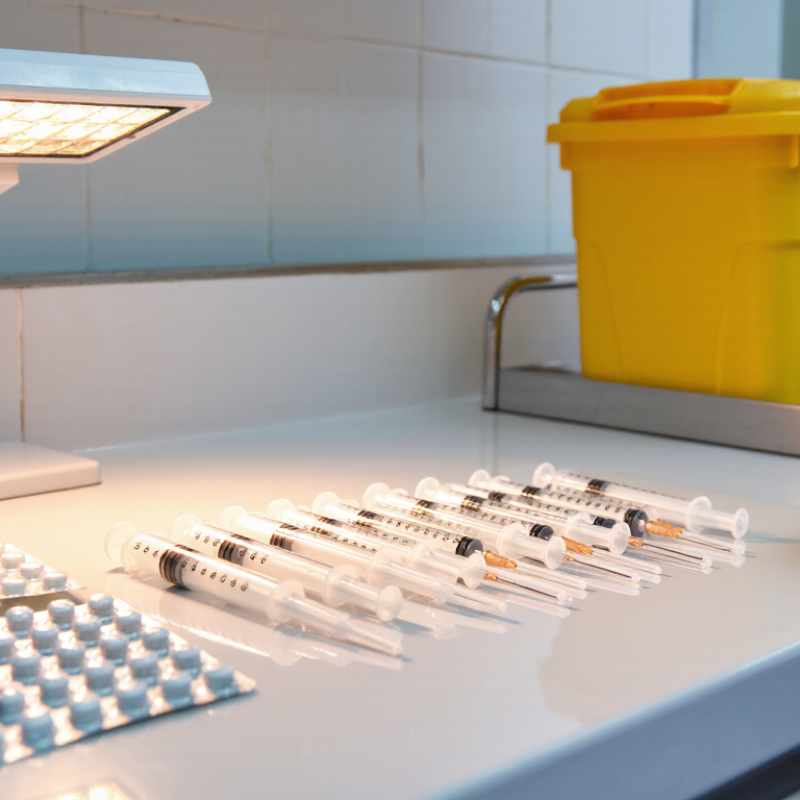
Choosing a disposable syringe starts with the procedure, not the package. ISO 7886-1:2017 covers sterile, single-use, manually operated syringes and tests graduation, leakage, and piston performance. A 1 mL syringe suits small-volume dosing and clearer measurement. Larger 20, 30, 50, and 60 mL syringes support irrigation or fluid transfer. Select the smallest practical size. Oversized barrels can reduce measurement accuracy. WHO injection-safety data estimate that about 16 billion injections occur globally each year, so small handling errors can affect many patients.
Sterility needs visible evidence. Check the sealed wrapper, expiry date, lot number, and damage before opening. Do not use a syringe with moisture, a loose seal, or unclear markings. Match the needle gauge and length to the approved clinical procedure. Never reuse a syringe, even when the needle changes. CDC injection-safety guidance identifies syringe reuse as a preventable route for cross-contamination. ISO compliance helps, but it does not replace local clinical protocols or trained judgment. This distinction is easy to overlook.
Tips: Keep unopened supplies dry and traceable. Open packages immediately before use. Place used devices directly into a puncture-resistant container. Do not recap unless a documented safety procedure requires it. A checklist helps, but it cannot replace attention. Recheck the volume at eye level. Mistakes still happen.
Choosing the right disposable syringe and needle begins with the injection route. Gauge describes needle thickness. A lower gauge number means a wider needle. An 18G needle is relatively thick, while a 25G needle is finer. Thicker needles can move viscous medication more easily, but they may cause more tissue discomfort. Finer needles can reduce discomfort, although delivery may take longer. Needle length also matters. A longer needle may reach deeper tissue. A short needle may not reach the intended layer. Too short can be unsafe.
For intramuscular injections, trained clinicians often choose an appropriate 22–25G needle, with length based on anatomy and injection site. Subcutaneous injections commonly use finer, shorter options, often within the 25G range. Intradermal procedures generally require very fine, short needles and precise technique. These ranges are general, not automatic instructions. Body size, medication thickness, age, and clinical purpose can change the selection. There is no universal best needle.
Use only sterile, unopened equipment. Check the package and expiration date before use. Never reuse a syringe or needle, even on the same person. Dispose of used sharps immediately in an approved sharps container. A clinician should confirm the route, gauge, and length before injection. Small details matter. I would not rely on habit alone, because a familiar needle can still be unsuitable for a different medication or tissue depth.
Disposable syringes are safer when their engineering matches the real workflow.
Retractable needles pull into the barrel after injection, reducing exposure during removal. Shielded designs cover the needle with a hinged or sliding guard. Safety-engineered syringes may combine these features with automatic locking.
The protection must activate easily.
The CDC estimates that U.S. healthcare workers experience about 385,000 needlestick and sharps injuries each year in hospitals. Its surveillance guidance also warns that reporting is incomplete.
The World Health Organization has reported roughly 16 billion injections globally each year, making small design weaknesses important at scale.
These figures support choosing devices with visible activation, one-handed operation, and a clear lock indicator.
During use, inspect the package and syringe before opening.
Keep fingers behind the needle path. Activate the shield immediately after injection, while the needle remains visible. Never recap a used needle, even when the procedure feels routine.
Place the entire syringe into a rigid, closable sharps container at arm’s reach. Do not force an overfilled container closed.
Retractable systems can reduce handling steps, but they may require firm thumb pressure. Shielded systems can snag on gloves or clothing if poorly positioned.
Staff should practice with training devices, then verify activation during competency checks.
Design alone is not enough.
A rushed user can defeat good engineering through awkward positioning or delayed disposal. These observations align with CDC sharps-safety guidance and OSHA’s Bloodborne Pathogens Standard.
Recheck local clinical procedures, because device instructions and disposal rules can differ.
Safe injection begins before the package opens.
A trained clinician performs hand hygiene and checks the seal, expiry date, syringe, and needle. Do not use damaged or wet packaging. Select equipment appropriate for the prescribed injection and patient. The syringe and needle must be sterile and single-use. One patient only. One procedure only. CDC guidance is clear: never reuse a syringe, even after changing the needle.
Prepare medication in a clean area, away from used equipment. Label prepared doses when timing could cause confusion.
WHO estimates that about 16 billion injections occur worldwide each year. This figure shows the scale of injection care, not permission to cut corners.
CDC safe injection practice requires a new sterile needle and syringe for every patient and every entry into a medication container. Clean vial tops with an appropriate antiseptic and let them dry. Never draw medication from a container with a used syringe. Avoid sharing single-dose containers. Multi-dose containers require strict facility policy. Follow local clinical protocols.
After administration, place the needle and syringe directly into a closable, puncture-resistant sharps container. Do not recap, bend, or break the needle by hand. If recapping is unavoidable, use only the approved one-hand method. Keep hands away from the needle tip.
A rushed room can make this step feel optional. It is not. Even experienced staff can miss a torn seal or crowded sharps bin. I would pause and recheck rather than guess.
Documentation should record the product, dose, route, time, and any unexpected reaction. Training, supervision, and incident review keep the workflow reliable.
Safe disposal begins before the injection. Use an FDA-cleared sharps container that is rigid, leak-resistant, puncture-resistant, and clearly labeled. Keep it upright on a stable surface, within arm’s reach, and away from children or animals. Drop used syringes and needles directly inside. Do not recap, bend, break, or remove the needle by hand. The World Health Organization estimates that healthcare workers experience about three million blood exposure incidents annually, showing why small handling errors matter.
Tips: Replace the container before it becomes overfilled. Follow the fill line, usually around three-quarters full. Seal it firmly, then follow local medical-waste instructions. Never place loose sharps in household recycling or a regular trash bag. FDA guidance also recommends checking community collection programs, pharmacies, or health departments for approved disposal routes. Rules differ by location, and that detail is easy to overlook.
After a needlestick, wash the area immediately with soap and running water. Do not scrub aggressively or squeeze the wound. If blood reaches the eyes, nose, or mouth, flush with clean water. Report the incident promptly to a supervisor or responsible clinician, and seek urgent medical evaluation. CDC guidance emphasizes rapid assessment because preventive treatment may be time-sensitive. Record the device, time, exposure route, and visible contamination. Even experienced users can hesitate during stress; practicing the response beforehand is imperfect, but safer than relying on memory.
Approximate nominal outside diameter by needle gauge. Higher gauge numbers indicate smaller needle diameters.
Needle gauge and length should be selected by a qualified healthcare professional for the intended procedure. Use a new sterile, single-use syringe and needle for every injection, never recap, bend, or manually remove a used needle, and place used sharps immediately into an approved, closable, puncture-resistant sharps container. Close and replace the container before it becomes overfilled, following local requirements and the container’s fill line. After a needlestick or splash exposure, wash the area with soap and water or flush mucous membranes with water, report the incident immediately, and seek urgent medical evaluation for exposure assessment and follow-up.
Gauge describes needle thickness. A lower number means a wider needle. An 18G needle is wider than a 25G needle.
Length determines how deeply the needle can reach. A short needle may miss the intended tissue layer. That can be unsafe.
Trained clinicians often consider 22–25G needles. Length depends on body size, anatomy, medication, and injection site.
Subcutaneous procedures often use shorter, finer needles. Intradermal procedures need very fine needles and precise technique. These are general ranges.
No. Medication thickness, age, tissue depth, and clinical purpose can change the choice. Habit alone is not enough.
Use sterile, unopened equipment. Check the package and expiration date. A qualified clinician should confirm the route, gauge, and length.
Place them directly into a rigid, leak-resistant, puncture-resistant sharps container. Keep it upright and nearby. Never recap, bend, or break used needles.
Wash the area with soap and running water immediately. Do not scrub hard or squeeze it. Report the injury and seek urgent medical evaluation.
Flush the area with clean water. Report the exposure promptly. Medical assessment may be time-sensitive.
Do not wait until the container is overflowing. Seal it near the fill line and follow local disposal rules. I might rely on memory, but practice is safer.
This guide explains how to choose and use disposable syringes and needles safely in 2026. It covers key selection factors, including ISO 7886-1 compliance, sterile packaging, and syringe capacities from 1 to 60 mL. Needle gauge and length should be matched to the intended injection route and procedure, with 18–25G options selected only according to qualified clinical guidance. It also compares retractable, shielded, and other safety-engineered designs that can help reduce accidental needlestick injuries.
The article presents a safe injection workflow based on single-use principles: never reuse a syringe or needle, inspect packaging before use, maintain aseptic technique, and follow professional instructions. It also highlights the scale of global injection use and the importance of immediate disposal in approved, puncture-resistant sharps containers. If an injury occurs, stop safely, wash the affected area, report the incident, and seek prompt medical evaluation according to local procedures. Understanding How to safely use disposable syringes and needles supports safer handling for patients, caregivers, and healthcare professionals.

Seaoriva Medical