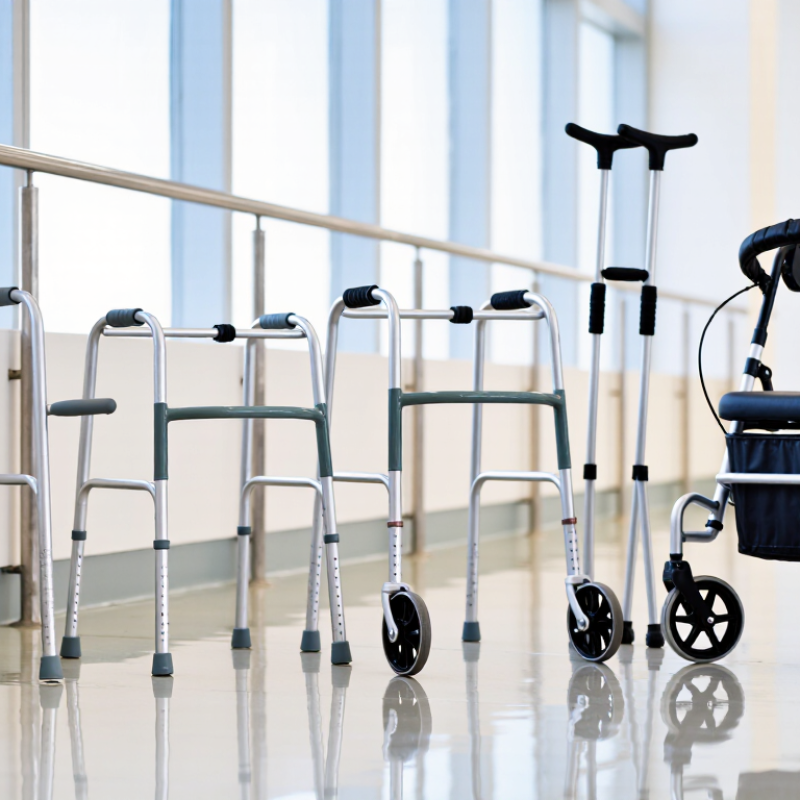
| 1 |
Standard Underarm Crutches |
Approx. 150–198 cm |
100–136 kg |
2.0–3.0 kg per pair |
Axle height and handgrip height; usually 5–12 adjustment positions |
Short-term non-weight-bearing or partial-weight-bearing recovery after lower-limb injury |
Provides strong support and keeps weight off one leg |
Requires good arm strength, balance, and correct fitting; pressure should not rest on the armpits |
| 2 |
Forearm Crutches |
Approx. 145–198 cm |
100–136 kg |
1.2–2.0 kg per pair |
Handgrip and cuff height; adjustable forearm cuff position |
Longer-term mobility training and users who need to walk with a more upright posture |
Allows better arm movement and avoids underarm pressure |
Needs adequate grip, wrist, and trunk control; may be less stable for beginners |
| 3 |
Platform Forearm Crutches |
Approx. 150–198 cm |
100–160 kg |
2.5–4.0 kg per pair |
Platform height, handgrip position, and cuff adjustment |
Recovery when the wrists or hands cannot tolerate normal crutch loading |
Transfers part of the load to the forearms and offers broad upper-limb support |
Heavier and less maneuverable; professional fitting is recommended |
| 4 |
Hemi Walker |
Approx. 145–190 cm |
100–160 kg |
2.0–3.5 kg |
Handle height; some models fold for storage |
One-sided support for users with weakness on one side of the body |
More stable than a cane while allowing one hand to remain free |
Must be placed carefully on the stronger side; not suitable for severe balance loss |
| 5 |
Standard Folding Walker |
Approx. 145–198 cm |
100–159 kg |
2.0–3.5 kg |
Leg-height adjustment, commonly in 2.5 cm increments; folding frame |
Early-stage rehabilitation requiring maximum stability and slow, controlled steps |
Four stable contact points and a lightweight, simple frame |
Must be lifted during walking; unsuitable for users unable to lift the frame safely |
| 6 |
Two-Wheel Walker |
Approx. 145–198 cm |
100–159 kg |
2.5–4.0 kg |
Height-adjustable legs; front wheels and rear glide caps or rubber tips |
Progressive recovery when the user needs stability but can advance the walker without lifting it |
Smoother forward movement with more stability than a rollator |
Wheels should remain controlled; not ideal for users who cannot manage forward momentum |
| 7 |
Four-Wheel Rollator Walker |
Approx. 145–198 cm |
100–159 kg |
6.0–10.0 kg |
Handle height, hand brakes, locking brakes, and often a folding frame |
Community mobility and later-stage rehabilitation for users with moderate balance and endurance |
Easy to propel and commonly includes a seat and storage basket |
Requires reliable brake use; it can roll away if the brakes are not locked |
| 8 |
Three-Wheel Rollator |
Approx. 145–198 cm |
100–136 kg |
4.5–7.0 kg |
Handle height, hand brakes, and compact folding mechanism |
Indoor use and situations requiring a smaller turning radius |
Lightweight, compact, and highly maneuverable in narrow spaces |
Usually less stable than a four-wheel model and often has no built-in seat |
| 9 |
Bariatric Heavy-Duty Walker |
Approx. 150–198 cm |
160–225 kg |
3.5–6.0 kg |
Reinforced frame, wider handgrip spacing, and height-adjustable legs |
Rehabilitation for larger users who need a wider and stronger support base |
Higher load rating and increased frame durability |
Wider and heavier than standard walkers; check doorways and turning space |
| 10 |
Gait-Training Walker with Forearm Supports |
Approx. 150–198 cm |
100–159 kg |
6.0–12.0 kg |
Forearm trough height, handgrip position, frame width, and brake adjustment |
Supervised gait training for users with limited hand grip or reduced trunk control |
Supports upright posture and can accommodate advanced rehabilitation exercises |
Usually intended for clinical or therapist-supervised use; not ideal for unsupervised outdoor walking |
 Seaoriva Medical